
Home
This Kasaragod mansion brings a contemporary touch to Malabar's vernacular style
Architect Rajesh George and interior designer Divya Rajesh create a sprawling river-front mansion that trains a contemporary lens on the native vernacular.
Perched on the banks of the Chandragiri river in Kerala, a sprawling family home blends the architectural vernacular of the Malabar coast with contemporary design. This Kasaragod mansion is a 8,500-square-foot property accompanied by an 1,100-square-foot outhouse, designed by Ernakulam-based interior and architecture firm Paushtika Architectural Design Consultancy, with landscape design by their sister concern, Prakrti Environmental Design Consultancy.
Justin Sebastian
The client had come across one of the firm’s more ambitious projects, “A very wild, rustic project, set in the forest,” explains principal architect Rajesh George, and wanted something similar for his river-perched plot in Kasaragod. “The site itself was almost completely flat,” adds Rajesh, who worked closely with principal architect Sajeev KG on the architecture, while the firm’s third principal architect, Divya Rajesh led the interior design. “From the back of the site, you couldn’t see the river at all–the site itself obscured the views of the water.”
Justin Sebastian
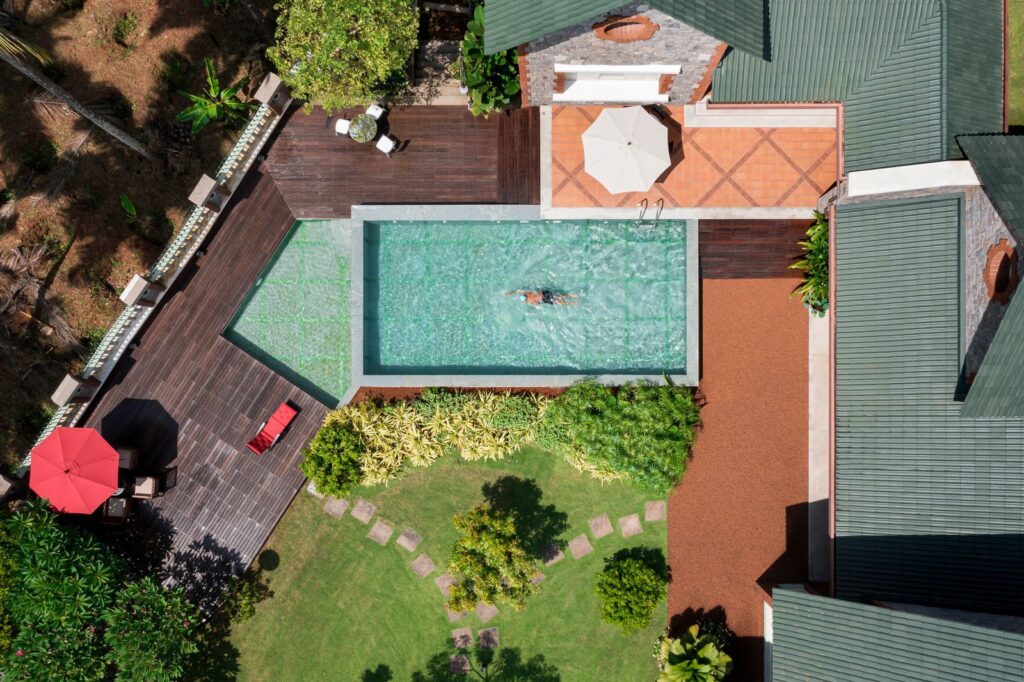
The building has been designed in two distinct parts, connected by a corridor: a main house for the family, and a guest house that also accommodates the office. On the far side of the house is the office block, fitted with a home office, guest bedroom and pool room, purposefully designed to accommodate professional acquaintances without disturbing the family.
Justin Sebastian
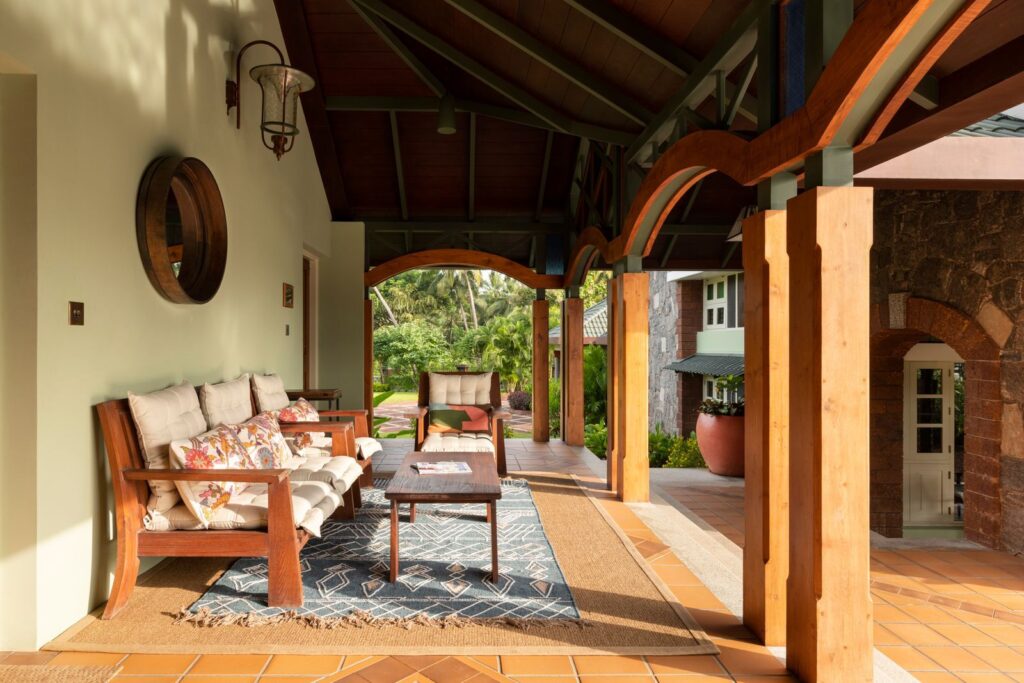
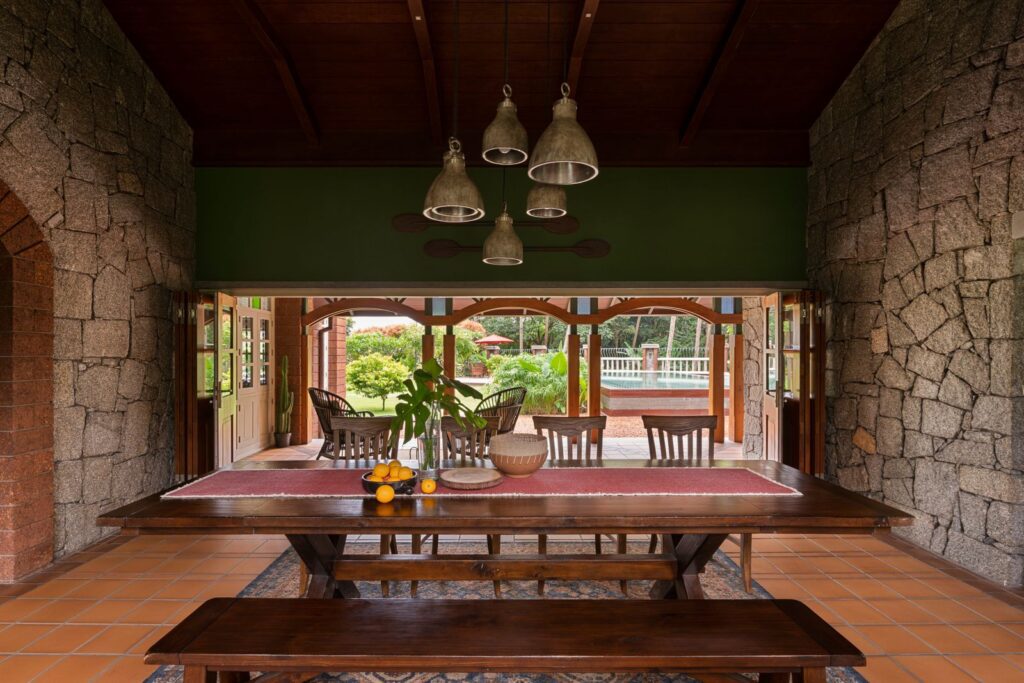
Beyond the pool, a verandah connects all the living spaces of the home–including the dining room, the formal drawing room and the informal family living room. At the far end, the children’s bedroom and the client’s mother’s bedroom are stacked on top of the other. Finally, a pergola leads into a home theatre above which sits the master bedroom.
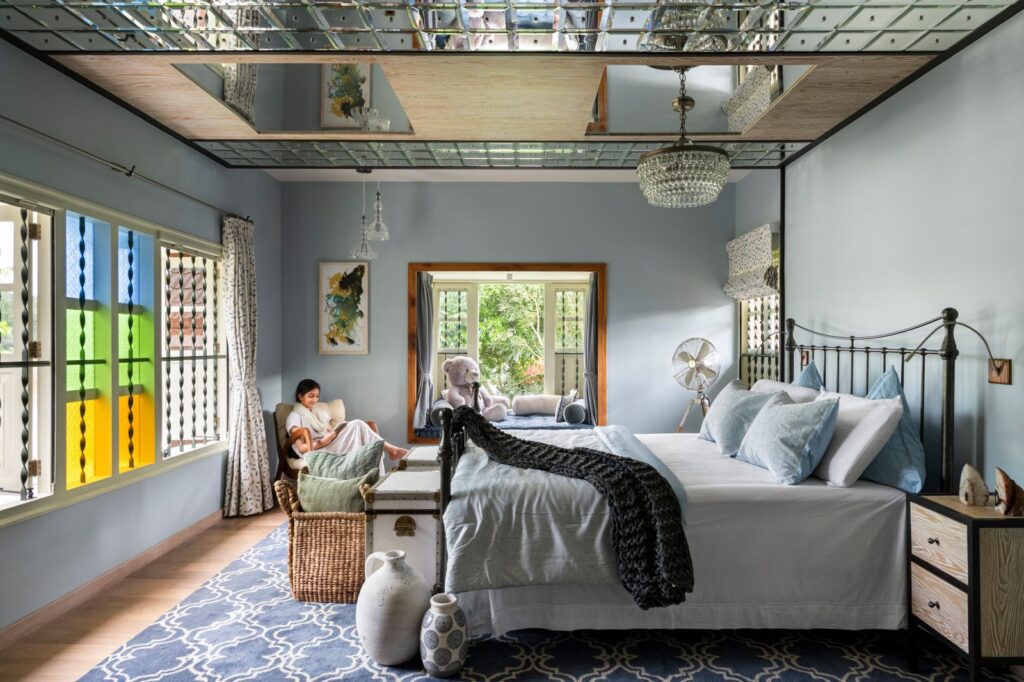
The shell of the children’s room references the vernacular, but an interplay of metal and mirrors makes for a contemporary interior design story. Justin Sebastian
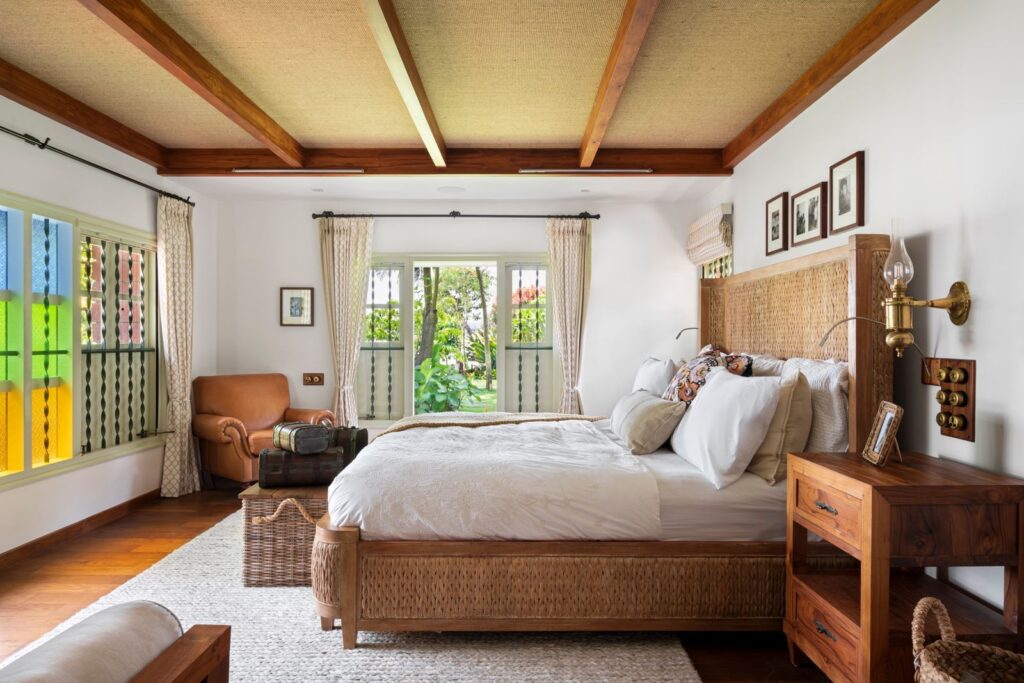
Cane is the material of choice in the client’s mother’s bedroom, perfectly balancing the vernacular elements of wood, twisted window bars and coloured glass. Justin Sebastian
“They have a very segregated system of entertaining guests,” explains Rajesh. “The family guests come to the house, the business guests come to the formal drawing room and the guest house.” As a result, the house has three entrances–one that leads from the car porch towards the formal drawing room, another that leads into the guest block, and a third that stands next to the kitchen. “You don’t actually have to go through the main house to go to the pool deck,” Rajesh adds.
TRENDING VIDEO
Inside Ananya Panday's First Home in Mumbai Designed by Gauri Khan | AD India
Justin Sebastian
Justin Sebastian
An artificial incline, created from formed earth, creates a subtle gradation by which many of these rooms–including the verandah and the pool deck–still have ground access. “The pool is actually sitting at a level much higher than what the ground used to be,” Rajesh offers as an example, “The whole ground was raised by one floor.” The rooms that didn’t require a view–the home theatre, for instance, or the parking garage–were placed on the lower levels, while the bedrooms, living rooms and dining areas were all placed on the higher levels.
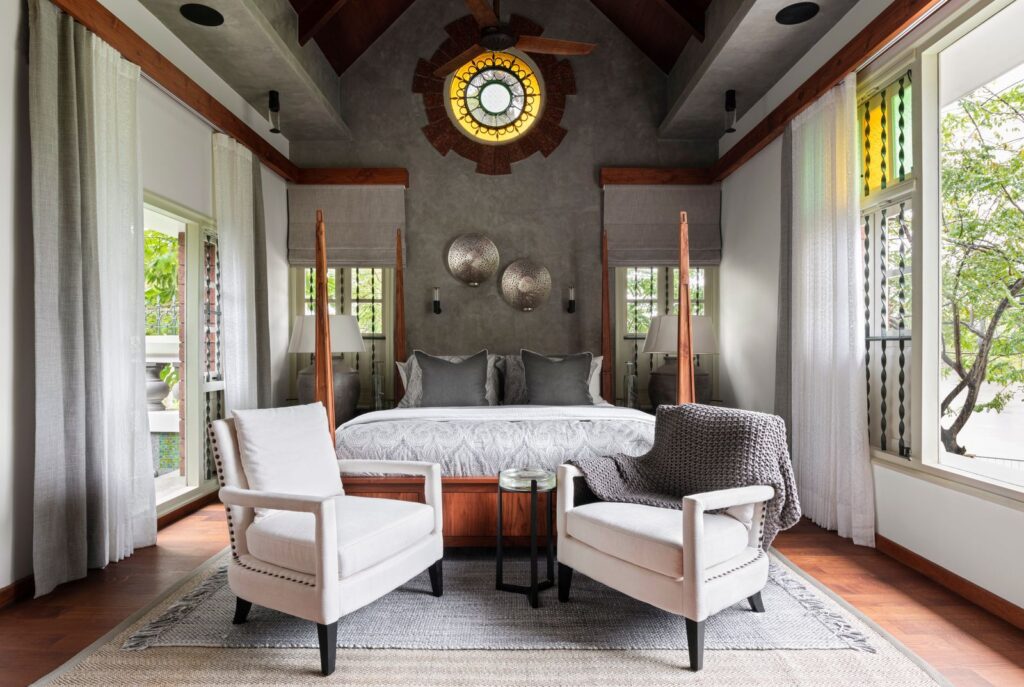
The master bedroom witnesses a palette of wood and cement, anchored by a coloured glass window that references Kasargaod’s colonial heritage. Justin Sebastian
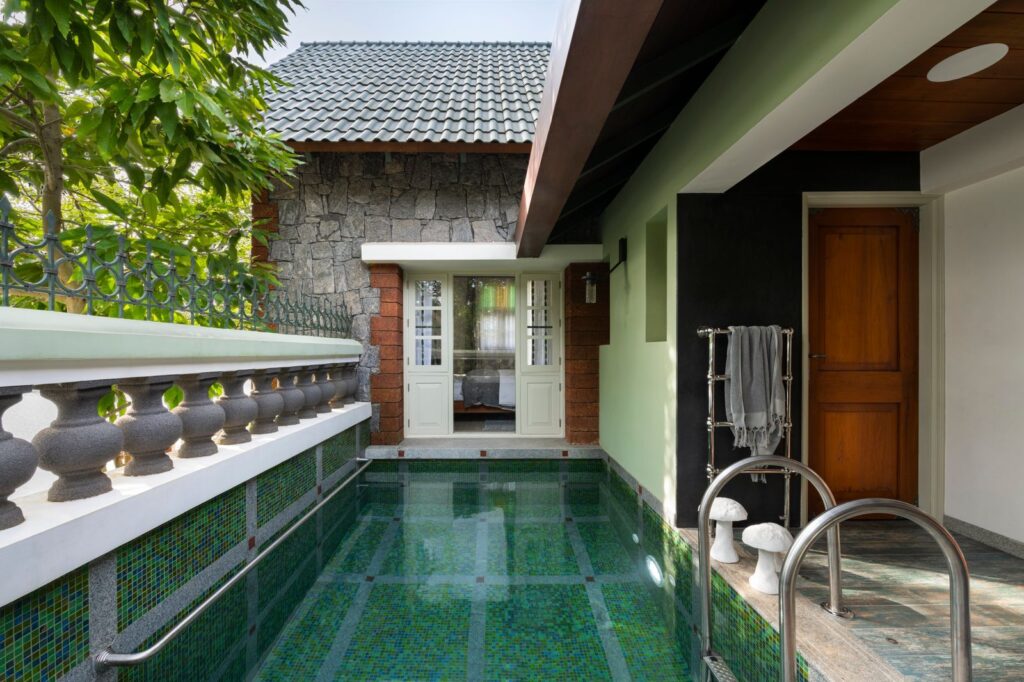
The master bedroom, which is on the first floor, has its own plunge pool that makes it seem connected to the ground. Justin Sebastian
Read more: A century-old colonial mansion turned into a boutique stay in Matheran
The project itself was over a decade in the making–the firm began work in 2009, and finished only in 2021. “By the end of the project, the client was practically a different person than the one we started with,” laughs Rajesh. The house, one could argue, is all the richer for it–underlined with the rustic elements from the client’s original brief, and then layered with more contemporary details.
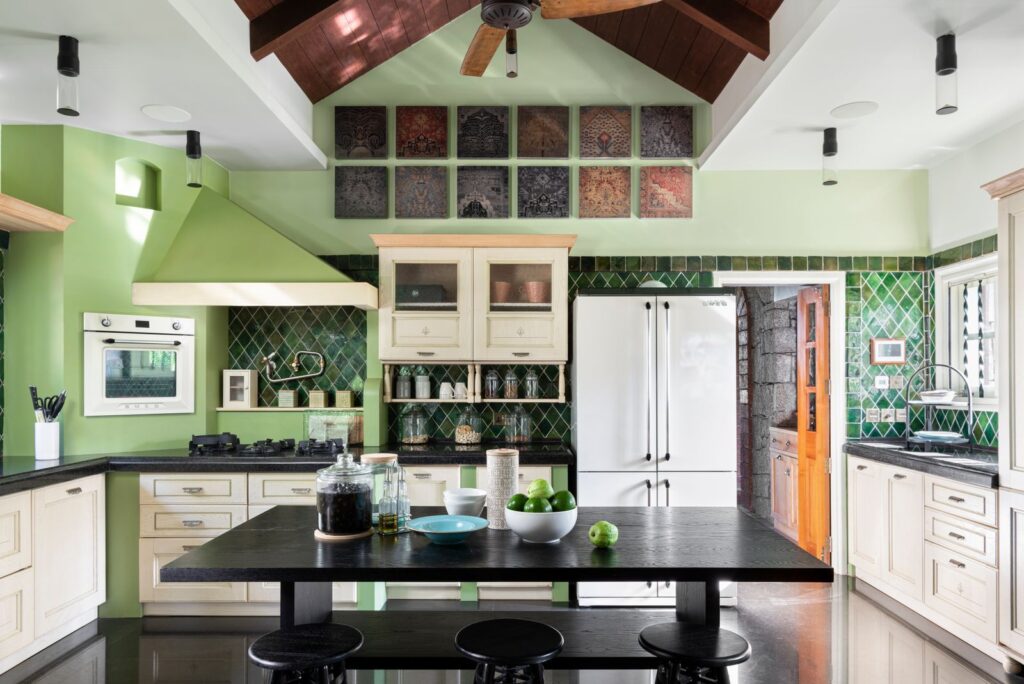
Moroccan tiles and white woods create an interplay of rustic farmhouse and Italian contemporary aesthetics in the kitchen. Justin Sebastian
The room that best exemplifies the client’s evolving tastes is the kitchen, which was at first designed to have a “rustic, farmhouse” feel. Later, the brief got a lot more complicated. “He wanted us to set it in a way that looked as if it was an old kitchen that had then been renovated,” explains Rajesh.
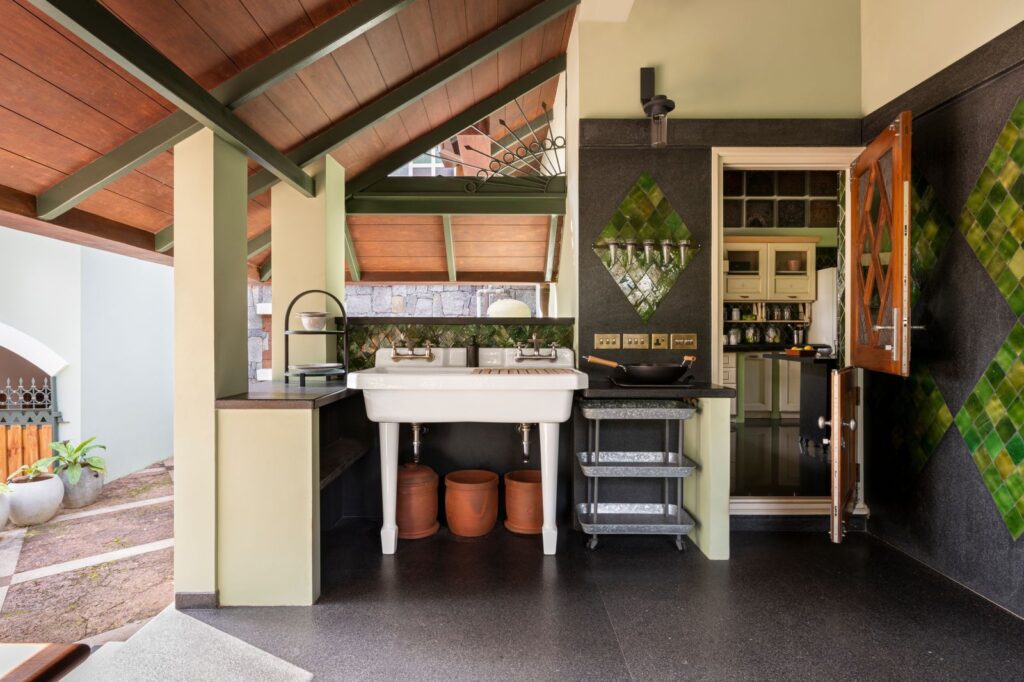
The kitchen verandah serves as the third formal entryway into the house, gently ornamented with a wall arrangement of green Moroccan tiles. Justin Sebastian
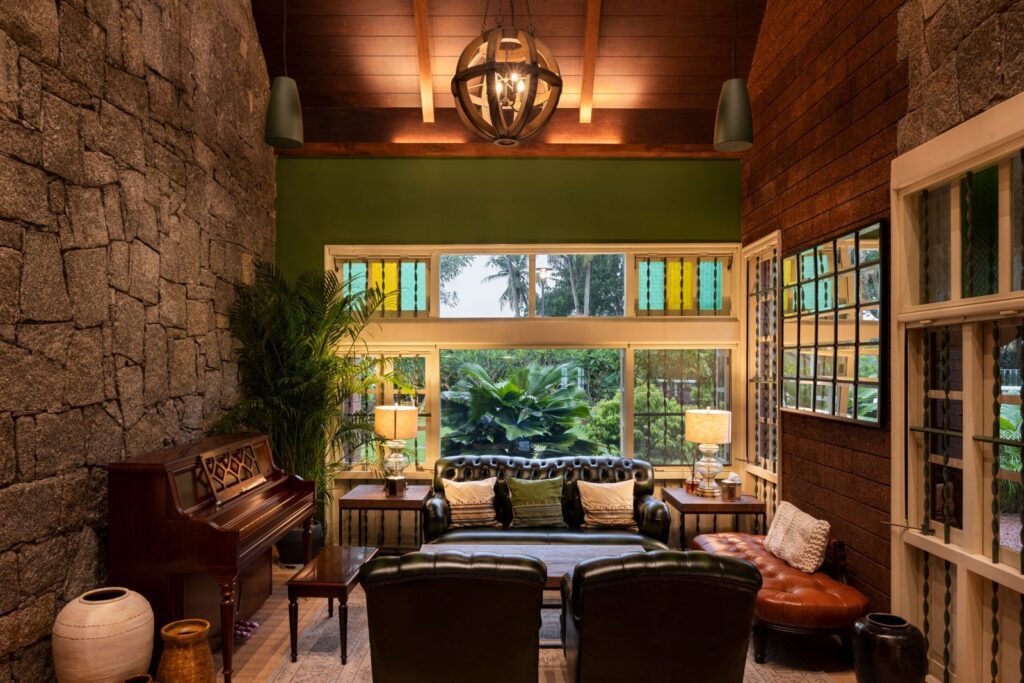
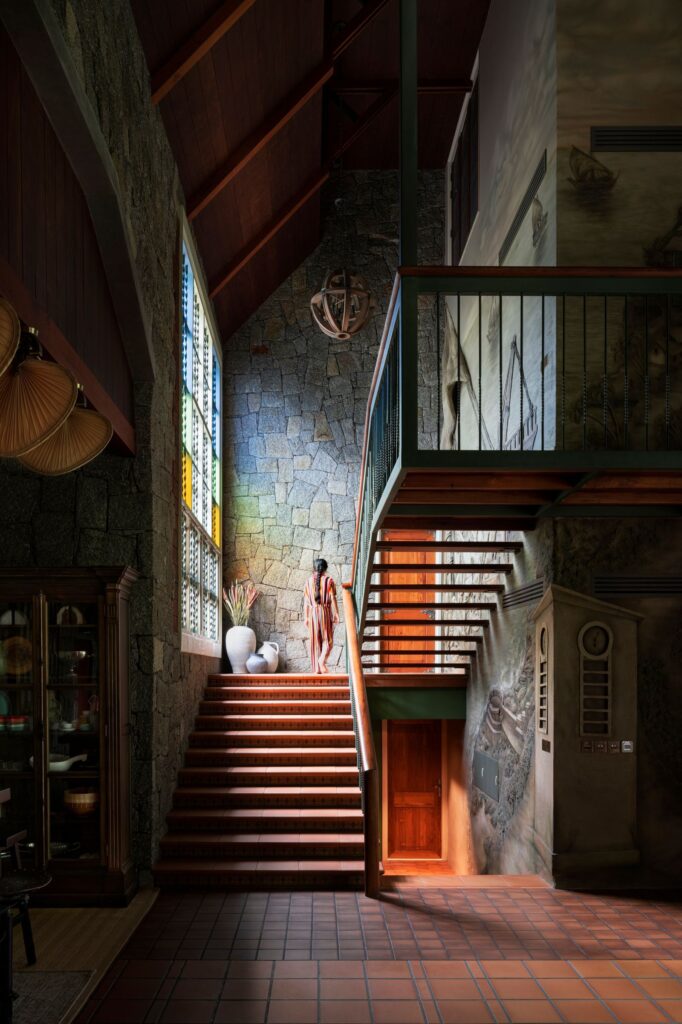
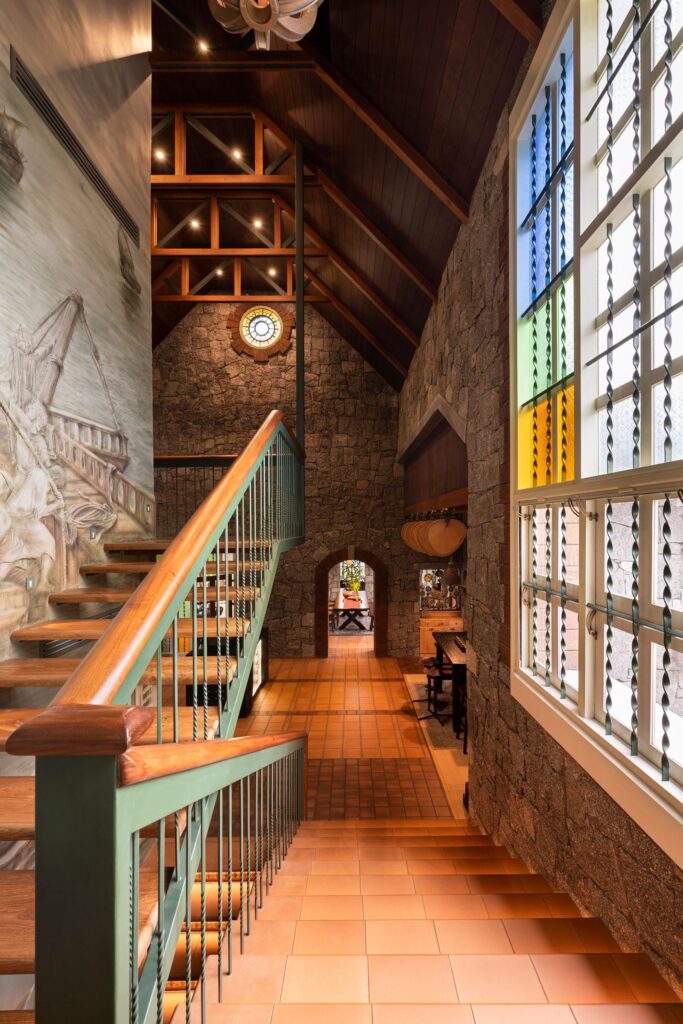
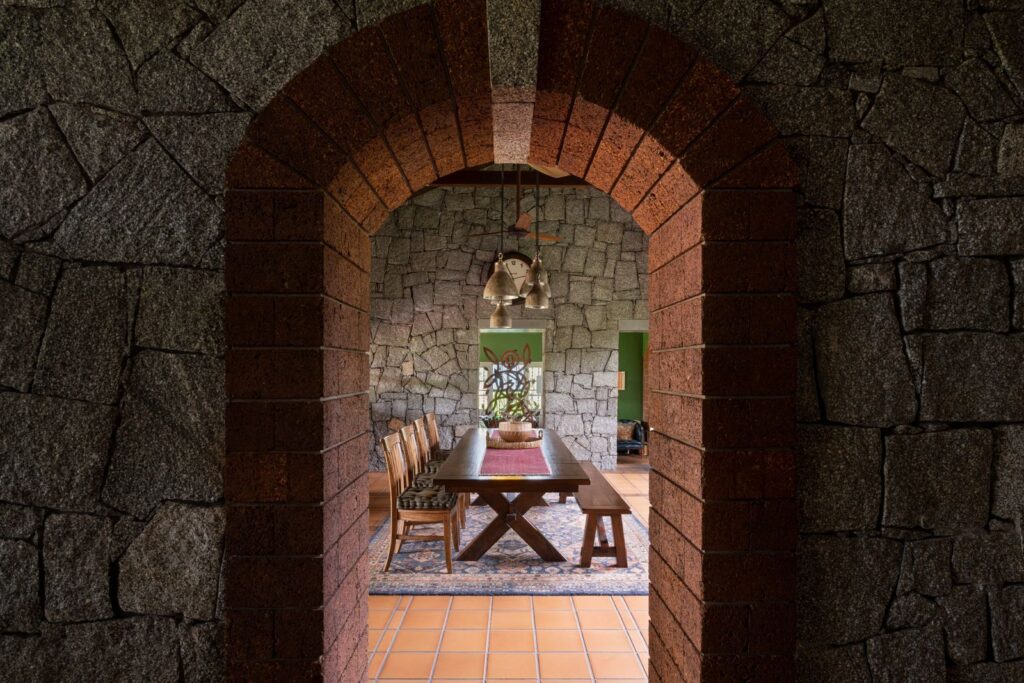
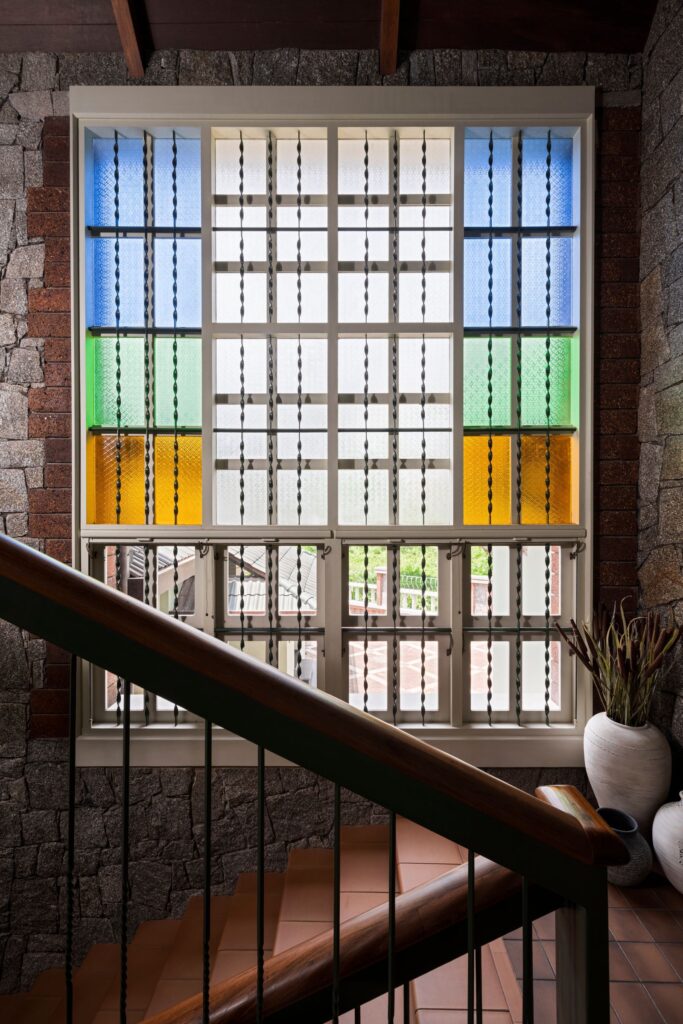
The vernacular of Malabar is a hybrid vernacular, heavily influenced by the colonisers that came in the 19th century. “The erstwhile rich used to copy the British,” Rajesh explains, “That’s where you get the coloured glass and the arches.” He points out the twisted steel window bars, modeled in the native style. Where the erstwhile homeowner would have commissioned the bars in hand-carved wood, Rajesh chose to work with a contemporary interpretation in wrought metal for this Kasargod mansion. “We picked up a material that is not at all traditional, but then applied the logic of traditional vernacular to that,” he expresses.
Justin Sebastian
Justin Sebastian
Justin Sebastian